Will AI Push Young Audiences Back Toward the Stage?
by Cassidy Sara
With the onrush of AI-generated elements onto movies, television, media advertising - even music! - there is widespread concern this could ring a death knell for these entertainment industries. However, could this also lead to an unexpected ironic twist? One where the more sophisticated our synthetic media becomes - and indeed AI-generated chatbots can hold a conversation better than most humans - the more some young people seem to crave the opposite: a room full of strangers, a performer who might flub a line, and an experience that can't be paused, skipped or regenerated. There's no question AI will continue expanding into entertainment. The interesting question is whether that expansion creates a counter-current - a generational pull back toward live theater, variety acts, sporting events, and other unmistakably human performances.
Oversaturation
Gen Z and Gen Alpha are the first to grow up genuinely saturated with algorithmically generated content. For older generations, AI entertainment is a novelty layered upon a media diet built on familiar platforms of television, radio, and film. For teenagers today, it's closer to wallpaper. They have no recollection of a show that can't be paused, rewound, or called up on demand. Of an image that can't be zoomed in with the touch of a finger, or song lyrics that can't be pulled from the ether at will. Younger audiences are remarkably comfortable with AI as a creative tool and consume enormous amounts of synthetic or AI-assisted media without a second thought. This saturation is a double-edged sword, however. AI content is omnipresent and increasingly indistinguishable from human-made content. That comfort can degrade into fatigue and skepticism, where the reality of everything feels inherently questionable.
Throughout time, every leap in media technology has triggered some version of this same anxiety and potential for countercurrent. Radio was supposed to kill live music; instead it built bigger audiences for concerts. Television was supposed to kill theater, but Broadway adapted and endured. Streaming was supposed to kill recording studios and movies, yet theaters continue to break attendance records while mainstream and indie music productions flourish. AI may simply be the latest technology to trigger this cycle, only faster and more intensely, as it doesn't just reproduce content, it originates it.
The "Live" Difference
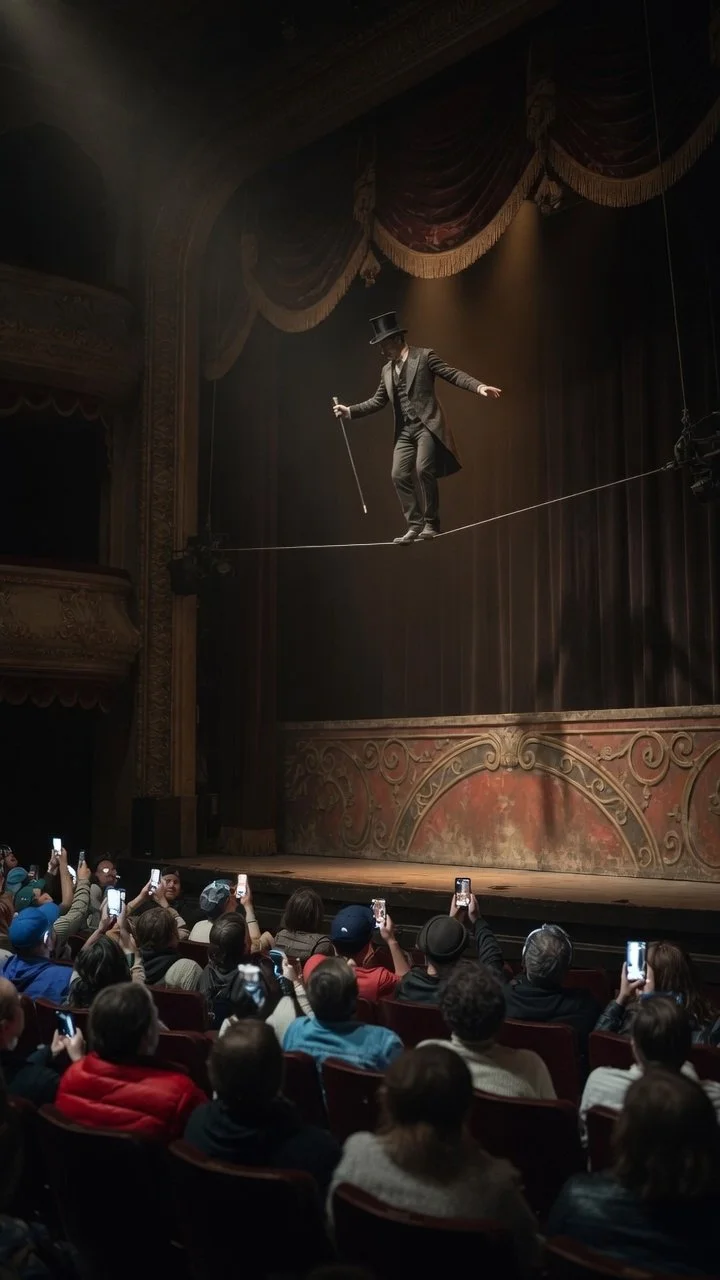
An AI-composed symphony, hologram concert, or computer-driven drone display can certainly be technically dazzling. Some could argue even more dazzling than what could be achieved by mere mortals on a stage. So what drives that elemental satisfaction in viewing a live performance? In some capacity it's about the stakes. A theater audience knows, at a subconscious level, that the actor on stage could forget a line, that the trapeze artist could miss a catch, that the comedian's joke could bomb in real time. The fragility and uncertainty is the point. It converts the audience from passive consumer into witnesses. In another capacity, it's about the trueness, the irreproducibility of the moment. You can't rewind a live event, and you can't be certain it will go the same way twice, which is precisely what makes it feel earned rather than manufactured. This same feeling is what has made sporting events so enduringly appealing.
There's also a social dimension that AI struggles to replicate. Vaudeville, in its heyday, was just a form of entertainment - it was a shared civic ritual, a place where the community gathered, reacted together, and left with a collective memory rather than an individually curated one. Every culture and period of time has utilized a form of shared communal entertainment to bind society together. In today's increasingly isolated world, we see the younger generations gravitating towards available shared-experience communal spaces like immersive theater, escape rooms, live improv, sporting events, and pop-up concerts. Digital algorithms can't personalize away the desire for shared experiences in social settings that aren't home or work.
Signs of Resurgence
There are real, tangible signs pointing toward renewed interest in live and varied performances among younger audiences. Immersive and site-specific theater productions have drawn younger, more diverse crowds than traditional stage shows. Comedy clubs have seen a boom, partly fueled by short-form clips driving people to see performers in person, rather than replacing it - an interesting juxtaposition of the digital world with the live. Circus arts, burlesque, drag performances, and cabaret - all direct descendants of the vaudeville variety tradition - have found dedicated, youth-skewing audiences in cities that support them. Neighborhood trivia nights are packed with groups of young friends sharing a social night out. Karaoke bars and open mic nights have also seen renewed popularity as spaces for participation rather than purely observational entertainment. Live sporting events continue to garner record audiences, including the smaller municipal and minor league levels.
A Cycle, Not a Verdict
This is not to suggest the younger generations are rejecting AI-driven entertainment. Young audiences increasingly consume enormous quantities of low-effort, AI-assisted content in private, while simultaneously placing a premium on rare, high-effort human experiences in public. Also, live experiences are undeniably expensive and can be cost-prohibitive to many. Concert and major theater production tickets have climbed well beyond the reach of many young people, and cities with vibrant, accessible live performance scenes are the exception rather than the rule. AI-driven entertainment, meanwhile, is only going to become cheaper, more personalized, and more emotionally responsive, potentially closing the gap between the two. For now, however, the two aren't necessarily in competition. Rather this is a bifurcation and level of discrimination that perhaps only a generation inundated from birth can discern. AI will keep colonizing more of entertainment, and a meaningful segment of younger audiences will keep pushing back toward live, human, unrepeatable experiences. If anything, the ambient presence of AI in daily life may be raising the perceived value of anything that is unmistakably, verifiably human. At least for now.